
4 Doves (& Pigeons) That Live In Canada!

What kinds of doves can you find in Canada?

Doves and pigeons (which is what larger doves are typically called) are stocky birds characterized by short necks, short slender bills, and a diet that is heavy on seeds. Due to their apparent peaceful nature, they are popular birds and a common visitor to backyards!
Today, you will learn about 4 types of doves that live in Canada!
If you’re interested, you may be able to see a Mourning Dove at my bird feeding station right now! I have a LIVE high-definition camera watching my feeders 24/7. 🙂
For each species, I provide some fun facts along with how to identify them by sight OR sound. Make sure to pay attention to the range maps to see which doves live near you!
The 4 Species of Doves That Live in Canada:
#1. Mourning Dove

Identifying Characteristics:
- A mostly grayish dove with large black spots on the wings and a long thin tail.
- Look for pinkish legs, a black bill, and a distinctive blue eye-ring.
- Males and females look the same.
Mourning Dove Range Map

This species is the most common and familiar dove in Canada.
Look for them perched high up in trees or on a telephone wire near your home. They are also commonly seen on the ground, which is where they do most of their feeding.
Mourning Doves are common visitors to bird feeding stations!
To attract them, try putting out their favorite foods, which include millet, shelled sunflower seeds, Nyjer seeds, cracked corn, and safflower seeds. Mourning Doves need a flat place to feed, so the best feeders for them are trays or platforms. To be honest, they probably are most comfortable feeding on the ground, so make sure to throw a bunch of food there too.

Mourning Doves are prolific breeders! It’s common for females to have 3 to 6 broods each breeding season. The young only stay in the nest for a maximum of 15 days, but they stay nearby to be fed by their parents for roughly another week. Many people mistakenly think these young doves have fallen out of the nest since they can barely fly, and have no idea that the parents are nearby and still providing food for the hatchling.
It’s common to hear Mourning Doves in Canada.
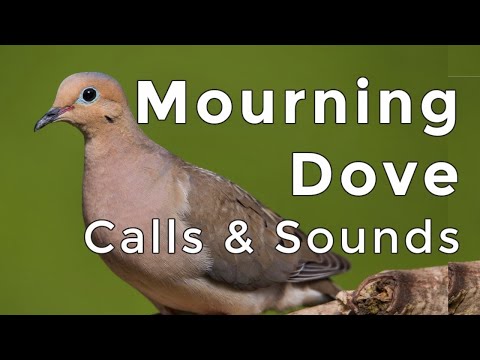
Listen for a low “coo-ah, coo, coo, coo.” In fact, this mournful sound is how the dove got its name! Many people commonly mistake this sound for an owl. (Press PLAY below!)
#2. Rock Pigeon

Identifying Characteristics:
- A plump bird with a small head, short legs, and a thin bill.
- The typical pigeon has a gray back, a blue-grey head, and two black wing bars. But their plumage is highly variable, and it’s common to see varieties ranging from all-white to rusty-brown.
Rock Pigeon Range Map

Rock Pigeons are extremely common doves in Canada, but they are almost exclusively found in urban areas. These birds are what everyone refers to as a “pigeon.” You have probably seen them gathering in huge flocks in city parks, hoping to get tossed some birdseed or leftover food.
Pigeons are easily attracted to bird feeders, especially if there is leftover food lying on the ground. Unfortunately, these birds can become a bit of a nuisance if they visit your backyard in high numbers. Many people find their presence overwhelming and look for ways to keep them away!
These birds are easy to identify by sound. My guess is that you will already recognize their soft, throaty coos. (Press PLAY below)
Love them or hate them, Rock Pigeons have been associated with humans for a long time! Some Egyptian hieroglyphics suggest that people started domesticating them over 5,000 years ago. And because of these facts, scientists aren’t even sure where their original range was.
#3. Eurasian Collared-Dove
Identifying Characteristics:
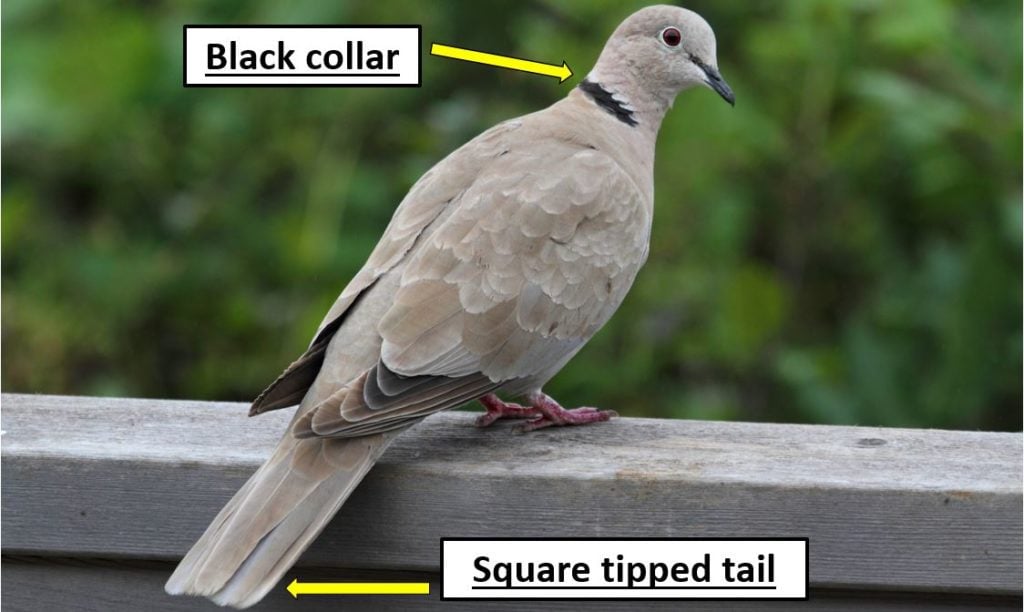
- A mostly sandy brown bird with a long, square-tipped tail.
- As the name suggests, look for a black collar on the back of the neck.
Eurasian Collared-Dove Range Map

Eurasian Collared-Doves are invasive to Canada.
Unfortunately, somebody introduced them to the Bahamas in the 1970s, and since then, they have rapidly spread. In fact, their population is still spreading!
One of the reasons that these doves colonized here so quickly is due to their comfort level with humans. They have thrived being around bird feeders and in urban and suburban areas. It’s common to see them on the ground or platform feeders eating grains and seeds.
Listen for a “koo-KOO-kook” song, which is given by both sexes. The middle syllable is longer than the first and last one. Males sing louder when defending their territory or searching for a mate.
How do you tell them apart from Mourning Doves?
At first glance, Eurasian Collared-Doves look very similar to Mourning Doves. Here’s how to tell them apart:

- Mourning Doves are smaller and have black dots on their wings.
- Eurasian Collared-Doves are larger and have a black crescent around their neck.
#4. Band-tailed Pigeon

Identifying Characteristics:
- A large dove with grayish wings and back. Underparts are purple-gray.
- Thin, yellow bill with a dark tip.
- Look for a white bar on the back of their neck, which sits above a patch of greenish iridescent feathers. This feature should help you distinguish this dove from a Rock Pigeon.
If you see one Band-tailed Pigeon, then you should expect to see many more! These doves spend most of their time traveling in large groups, which can include hundreds of birds.
Band-tailed Pigeon Range Map

Naturally, look for these doves in Canada in mature coniferous or mixed forests. But they have adapted well to people and can be found in wooded suburban areas visiting backyard bird feeders. In addition to seeds, these doves also eat a lot of berries and fruit!
Band-tailed Pigeons can be hard to see since they spend much of their time at the tops of large trees. You may have more luck listening for them while walking through the woods.
Males produce soft, deep, slow coos that rise slightly in pitch. Some people think they sound familiar to an owl hooting.
Which of these doves have you seen before in Canada?
Leave a comment below!

