
10 Types of Blackbirds Found in Missouri! (ID Guide)

What kinds of blackbirds can you find in Missouri?

Blackbirds are incredibly abundant in Missouri. But while they are common, some of these species get a bad reputation because of their aggressive personalities and tendency to “bully” smaller songbirds at bird feeders (cough… European Starlings… cough).
The term “blackbird” is a bit wide-ranging. For the sake of this article, I only included species in the Icteridae family (except for #2), which consists of all New World Blackbirds, grackles, cowbirds, and even orioles! I think you will find that the more you learn about the below birds, the more you can appreciate them and their natural behavior.
Below you will learn about 10 types of blackbirds in Missouri!
If you’re lucky, you may be able to see blackbirds at my bird feeding station right now! I have a LIVE high-definition camera watching my feeders 24/7. 🙂
#1. Red-winged Blackbird
- Agelaius phoeniceus

Identifying Characteristics:
- Males are all black, except for a bright red and yellow patch on their shoulders.
- Females are brown and heavily streaked. There is a bit of yellow around their bill.
- Both sexes have a conical bill and are commonly seen sitting on cattails or perched high in a tree overlooking their territory.
Red-winged Blackbird Range Map

During the breeding season, these blackbirds are almost exclusively found in marshes and other wet areas. Females build nests in between dense grass-like vegetation, such as cattails, sedges, and bulrushes. Males aggressively defend the nest against intruders, and I have even been attacked by Red-winged Blackbirds while walking near the swamp in my backyard!
- RELATED: 10 LIVE Bird Feeder Cams From Around the World [Including MINE!]
When it’s the nonbreeding season, Red-winged Blackbirds spend much of their time in grasslands, farm fields, and pastures looking for weedy seeds to eat. It’s common for them to be found in large flocks that feature various other blackbird species, such as grackles, cowbirds, and starlings.
It’s possible to see these blackbirds in Missouri at your feeders!

WATCH a male and female Red-winged Blackbird on my feeders above!
To attract them, try offering a combination of grains, such as millet and cracked corn, along with sunflower seeds.
Red-winged Blackbirds are easy to identify by their sounds!
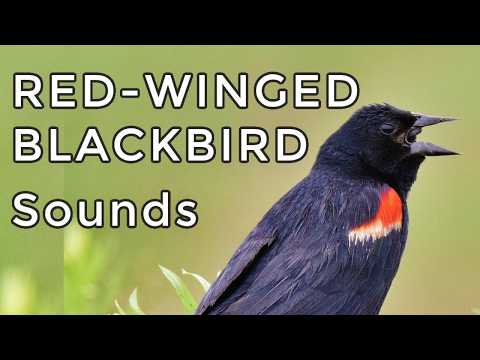
Listen to their common songs and calls by pressing PLAY above!
If you visit a wetland or marsh in spring, you are almost guaranteed to hear males singing and displaying, trying to attract a mate. Listen for a rich, musical song, which lasts about one second and sounds like “conk-la-ree!”
And at any time of year, you can hear males or females make a “check” call. This sound is used for many purposes, such as when flying, feeding, or defending their territory.
#2. European Starling
- Sturnus vulgaris – This is the only species on this list that isn’t in the Icteridae family.

Identifying Characteristics:
- A common blackbird in Missouri, they are about the size of an American Robin. Their plumage is black and appears to be shiny.
- Short tail with a long slender beak.
- Breeding adults are darker black and have a green-purple tint. In winter, starlings lose their glossiness, their beaks become darker, and they develop white spots over their bodies.
European Starlings are incredibly common in Missouri!
European Starling Range Map

But, did you know these birds are an invasive species and aren’t even supposed to be here?
Back in 1890, one hundred starlings were brought over from Europe and released in New York City’s Central Park. The man responsible (Eugene Schieffelin) had a mission to introduce all of the birds mentioned in Shakespeare’s plays in North America.
The rest is history as starlings easily conquered the continent, along the way out-competing many of our beautiful native birds. Their ability to adapt to human development and eat almost anything is uncanny to almost no other species.

When starlings visit in small numbers, they are fun to watch and have beautiful plumage. Unfortunately, these aggressive birds can ruin a party quickly when they visit in massive flocks, chasing away all of the other birds while eating your expensive bird food. To keep these blackbirds away from your bird feeders, you will need to take extreme action and implement some proven strategies.
Starlings are impressive vocalists!
Press PLAY above to hear their common songs and calls!
Listen for a mix of musical, squeaky, rasping notes. These blackbirds are also known to imitate other birds.
Here’s something amazing about European Starlings:
It’s the magical way they travel in flocks, called murmurations.

See the video above to watch an incredible display!
#3. Brown-headed Cowbird
- Molothrus after

- Look for a stocky, chunky blackbird with a thick, conical bill.
- Males have completely black bodies with a brown head (hence the name). In poor light, it can be hard to tell that the head is actually brown.
- Females are a plain brown color. There is slight streaking on the belly and a black eye.
Brown-headed Cowbird Range Map


Brown-headed Cowbirds are considered “brood parasites.”
Lastly, here is a question for you to ponder:
How does a Brown-headed Cowbird know it’s one? It’s interesting to think about since they aren’t raised by one of their own species. But after they leave the nest, they never spend time again with whatever type of bird their host mother was!
#4. Common Grackle
- Quiscalus quiscula

- Lanky, large blackbirds that have a long tail and long bill that curves slightly downward. Loud birds that gather in big flocks high in trees.
- Males are black overall but have an iridescent blue head and bronze body when seen in the right light.
- Females look similar, except they are slightly less glossy than males.
Common Grackle Range Map

Common Grackles are common visitors to bird feeders!

Watch my feeding station get taken over by Common Grackles!
These large, aggressive birds can become a bit of a nuisance when they arrive in large flocks as they scare away smaller songbirds. Unfortunately, due to their athletic ability and willingness to eat most foods, they are one of the harder creatures to prevent at backyard feeding stations.
#5. Baltimore Oriole
- Icterus galbula

Identifying Characteristics:
- Male birds are a stunning combination of orange and black with white wing bars.
- Females are beautiful in their own way, featuring duller colors than the males while lacking a black hood and back.
When you think about blackbirds in Missouri, you probably don’t think about Baltimore Orioles! But it’s true, as these stunning birds are members of the Icteridae family.
Baltimore Oriole Range Map

These blackbirds spend most of their time at the tops of deciduous trees, fluttering around, building beautiful woven nests, and looking for food.
They are most often found in open woodlands, riverbanks, and on the edges of swamps and forests. Even though they enjoy trees, they normally aren’t seen in deep, dark forests.
Baltimore Orioles LOVE eating ripe fruit and nectar!

Baltimore Orioles in MY Backyard!
These two sugary foods provide lots of energy, while insects give them the nutrition they need. Luckily, these birds are relatively easy to attract to your bird feeders, as long as you use the foods they enjoy eating.
Press PLAY above to hear a Baltimore Oriole singing!
Baltimore Orioles are often heard before being seen since they live so high up in trees. Listen for males to make a flutelike whistling noise while defending their breeding territory. Females also sing, but it’s shorter and used to communicate with their mates.
#6. Orchard Oriole
- Icterus spurius

Identifying Characteristics:
- Male Orchard Orioles are a darker orange than Baltimore Orioles. Their plumage is best described as rust-colored.
- Females are greenish-yellow, with white wing bars on black wings.
These vibrant blackbirds are common in Missouri during summer.
Orchard Oriole Range Map

But these shy birds are not often seen because they spend most of their time at the tops of trees. Preferred habitat includes the edges of rivers, swamps, lakeshores, open woodlands, farms, and scrublands. In winter, they migrate south to Central and South America.
While many oriole species regularly visit bird feeders, Orchard Orioles are much harder to attract to them.
You are probably more likely to see these blackbirds in your backyard searching for insects in shrubby vegetation or eating mulberries from a tree. But if you’re lucky, you may see them at your feeders eating sunflower seeds or orange slices, drinking sugar water from a nectar feeder, or sipping a bit of grape jelly.
Press PLAY above to hear an Orchard Oriole singing!
An Orchard Oriole’s song is similar to an American Robin, except it’s more varied. Listen for a series of loud whistles that lasts 3-4 seconds, which is used to attract mates.
#7. Brewer’s Blackbird
- Euphagus cyanocephalus

Identifying Characteristics:
- Males are completely glossy black with bright yellow eyes. If they are in the sun, you may see hints of blue, purple, and metallic green reflecting off their plumage.
- Females are plain brown with pale or brown eyes. They are dark brown on the wings and tail. They DO NOT have streaking, which differentiates them from female Red-winged Blackbirds.
Brewer’s Blackbird Range Map

Look for Brewer’s Blackbirds in Missouri in a variety of habitats, such as marshes, forests, meadows, and grasslands. These birds also adapt incredibly well to the presence of humans and are common in backyards, golf courses, parks, and agricultural areas.
Brewer’s Blackbirds are social birds. For example, they nest in colonies of up to 100 pairs of birds. Having that many eyes together helps watch out for and defend against predators.
After the breeding season is over, huge flocks come together to travel and search for food in grasslands and farm fields. It’s common to see mixed flocks that also include cowbirds, starlings, grackles, and Red-winged Blackbirds.
Listen for a metallic, creaky “ke-see” song, which lasts a bit less than a second. Brewer’s Blackbirds are vocal, and there are a few contact (“tschup“) and alarm (“chuck“) calls you may hear that they use to communicate with each other.
#8. Yellow-headed Blackbird
- Xanthocephalus xanthocephalus

Identifying Characteristics:
- Males are unmistakable and feature a bright yellow head and breast that contrasts against a black body. They also have distinct white wing patches.
- Females are brown overall. They can be identified from other blackbird species by looking for dull yellow plumage on their chest, face, and throat. If you look closely, you can also see faint white streaks extending down the breast.
During the breeding season, look for Yellow-headed Blackbirds in wetlands, where they raise their young. Females build nests in reeds directly over the water, and males aggressively defend their territories from other males and predators.
Yellow-headed Blackbird Range Map

These birds often share the same habitat as Red-winged Blackbirds. In these instances, the larger Yellow-headed Blackbird typically is dominant and gets to choose the prime nesting locations.
During winter, these blackbirds gather in huge flocks that forage in farm fields and other agricultural areas for grains and weed seeds. These massive gatherings often consist of multiple blackbird species.
When males are trying to attract a mate, you can hear them singing from cattails, small trees, shrubs, fences, shrubs, or bulrushes in the morning and evening. The song typically begins with a few short raspy notes, followed by a screeching buzz.
#9. Rusty Blackbird
- Euphagus carolinus

Identifying Characteristics:
- Medium-sized blackbirds with slightly curved, slender bills.
- Breeding males are entirely glossy black. Non-breeding males are a duller black but with rusty-brown edging on their plumage.
- Females appear rusty colored or brown. Look for a pale eyebrow that contrasts against the black feathers around their eye.
Rusty Blackbirds pose a concerning mystery to scientists.
In Missouri, they have declined dramatically over the past 40 years, and no one knows why!
Rusty Blackbird Range Map

The problem with studying these blackbirds is that they breed in Canada’s far northern boreal forests, where not many people are around to observe their behavior.
Their preferred habitats are wet forests, marshes, pond edges, and swamps. Many of these areas have been drained and converted to agricultural uses, which may play a part in the loss of Rusty Blackbirds.
It’s also thought that the severe hunting of beavers over the past century has eliminated many smaller ponds, which is also another natural home used by these blackbirds.
If you are lucky enough to be around a Rusty Blackbird, listen for a creaky song (“koo-a-lee-eek“) that is a few notes long.
#10. Great-tailed Grackle
- Quiscalus mexicanus

Identifying Characteristics:
- These blackbirds are fairly large, slender, and have long legs,
- Males are iridescent and completely black. Look for their bright yellow eyes and long V-shaped tail.
- Females are about half the size of males. Their upperparts are dark brown, while below, they feature paler brown plumage.
Great-tailed Grackles are brash blackbirds in Missouri that are often found in large flocks. It’s common to see them living near people, such as at parks, farms, landfills, or neighborhood backyards. Naturally, they live in open forests, marshes, and chaparral.
Great-tailed Grackle Range Map

Their range has spread over the past century because of their fondness for agricultural areas and urban areas. In fact, they are one of the fastest expanding species in North America!
Interestingly, it’s common for “sex-biased” populations of Great-tailed Grackles to occur where female birds greatly outnumber males. This happens for two reasons.
- #1. Females have a higher survival rate in the nest since they are smaller and require less food.
- #2. On average, females live longer than males.
Because of their wide array of vocalizations, it’s hard to describe the sounds that these blackbirds make! Descriptions of their whistles, squeals, and rattles include everything from “sweet, tinkling notes” to “rusty gate hinges.” Regardless, Great-tailed Grackles can sure make a lot of loud noises, especially when they gather in enormous flocks numbering in the tens of thousands!
Do you need additional help identifying blackbirds?
Here are a few books and resources you can purchase that will assist!
-
National Geographic Guide to the Birds of North America
-
The Stokes Field Guide to the Birds of North America
Which of these blackbirds have you seen before in Missouri?
Leave a comment below!
To learn more about other birds near you, check out these guides!

