
9 IRIDESCENT Birds found in Alaska! (2026)

Did you see a bird in Alaska that seemed to shine?

If so, you were lucky enough to observe a bird with iridescent plumage. These beautiful feathers appear shiny or glossy, especially when viewed in sunlight.
Below, you will find a list of birds with iridescent feathers. To help you make an identification, I have included several photographs of each species and detailed range maps.
9 Iridescent BIRDS in Alaska:
#1. European Starling
- Sturnus vulgaris

European Starlings are a common iridescent bird in Alaska!
Their breeding plumage in the summer appears shiny, especially when viewed in the sun. Look for a green-purple tint.
In winter, starlings lose their glossiness, their beaks become darker, and they develop white spots over their bodies.
But did you know these birds are an invasive species? Back in 1890, one hundred starlings were brought over from Europe and released in New York City’s Central Park. The man responsible (Eugene Schieffelin) had a mission to introduce all of the birds mentioned in Shakespeare’s plays in North America.
European Starling Range Map

The rest is history as starlings easily conquered the continent, along the way out-competing many of our beautiful native birds. Their ability to adapt to human development and eat almost anything is uncanny to virtually no other species.
It’s common to see starlings at my backyard bird feeders. Press PLAY below to see a LIVE stream of my feeding station:
#2. Rock Pigeon
- Columba livia

Rock Pigeons are extremely common in Alaska but are almost exclusively found in urban areas. These shiny birds are what everyone refers to as “pigeons.” You have probably seen them gathering in huge flocks in city parks, hoping to get tossed some birdseed or leftover food.
The typical pigeon has a gray back, a blue-grey head, and two black wing bars. In addition, look for a green and purple iridescence around their necks!
Rock Pigeon Range Map

Love them or hate them, Rock Pigeons have been associated with humans for a long time! Some Egyptian hieroglyphics suggest that people started domesticating them over 5,000 years ago. But, interestingly, scientists aren’t even sure where their original range occurs!
#3. Tree Swallow
- Tachycineta bicolor

Male Tree Swallows have a beautiful greenish-blue iridescence, which is especially striking in the sun. Females are not as bright or shiny in color and are much more brownish.
You will typically find these iridescent birds in Alaska near bodies of water, where they can find tons of insects to feed on. This species will even bathe by flying over the water, skimming their bodies on the surface, and shaking off the droplets.
Tree Swallow Range Map

Tree Swallows prefer to eat insects. After the breeding season, they gather in large groups, up to hundreds of thousands, to migrate.
#4. Mallard
- Anas platyrhynchos

My guess is that almost everyone is familiar with the Mallard. These ducks are the most common iridescent water birds in Alaska!
Males have a bright green head that shines brightly in the sunlight. Females are mottled brown with orange and brown bills. Both sexes have shiny purple-blue secondary feathers on their wing, most visible when standing or flying.
Mallard Range Map

Mallards are extremely comfortable around people, which is why these adaptable ducks are so widespread. They are found in virtually any wetland habitat, regardless of location. We even find these water birds in our swimming pool every summer and must chase them away so they don’t make a mess on our deck! 🙂
#5. Northern Shoveler
- Spatula clypeata

If you only glance at their shiny green heads, casual observers in Alaska might accidentally think these ducks are Mallards. But upon closer review, you should notice the ENORMOUS spoon-shaped bill, which is how Northern Shovelers got their name.
Males have iridescent green heads, a white chest, black backs, and yellow eyes. Females are brown, and sometimes, you can see a bluish shoulder patch.
Northern Shoveler Range Map

They use their large bill to shovel and sift through mud and sand to find tasty tidbits like crustaceans, mollusks, and aquatic insects. Interestingly, their bill has over 100 tiny projections on the edges called lamellae that help filter out the food they want to eat.
#6. Violet-green Swallow
- Tachycineta thalassina

At first glance, these swallows appear dark. But once the sun hits their feathers, you can truly appreciate their beauty as their metallic green backs and iridescent purple behinds become visible.
Your best chance at seeing these iridescent birds in Alaska is over open water.
Violet-green Swallow Range Map

Violet-green Swallows will fly over lakes, ponds, or rivers in the early mornings, hunting for insects. Since they tend to flock with other species of swifts and swallows, look for the birds with a white belly and cheeks.
Violet-green Swallows spend winters in Mexico and Central America. They are only in North America during the breeding season.
#7. Rufous Hummingbird
- Selasphorus rufus

Males have a bright copper-orange coloring on their back (although some males have a green back) and the sides of their belly. But their most striking feature is their beautiful reddish-orange iridescent throat.
Although not as vivid as the males, many females have a spot of shiny red or orange plumage on their throats.
Rufous Hummingbird Range Map

Rufous Hummingbirds build their nests with soft plants held together with spider webs. Like other hummingbird species, females prefer lichen, bark, and moss as camouflage.
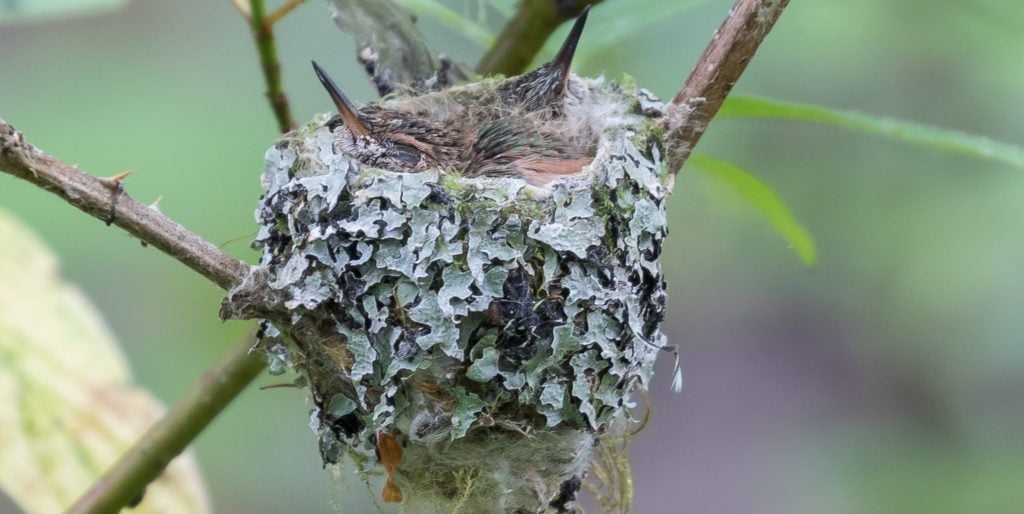
Rufous Hummingbirds are incredibly aggressive! Be careful if one finds your hummingbird feeders or garden, as they will relentlessly attack and drive away other hummingbirds (including much larger species).
#8. Black-billed Magpie
- Pica hudsonia

It’s hard to miss these shiny birds in Alaska!
Black-billed Magpies demand your attention. They are very social, noisy, and comfortable living amongst people and are commonly seen in smaller towns. Naturally, they live in open grasslands and plains and tend to avoid dense forests.
And in the right light, you can see beautiful blue iridescent feathers on the wings and tail.
Black-billed Magpie Range Map

Being part of the Corvid family, Black-billed Magpies are incredibly intelligent. One interesting behavior is that they seem to have funerals when discovering a deceased magpie. Individual birds will begin calling loudly to attract more magpies, eventually having as many as 40 birds gathered for 10-15 minutes before flying away silently.
#9. Anna’s Hummingbird
- Calypte anna

These tiny iridescent birds are no larger than a ping-pong ball and weigh about the same as a nickel.
Males are best known in Alaska for their iridescent pinkish-red heads. The tail and back are dark and shiny green. Most of the time, a broken white eye-ring is visible.
Females are duller than the males, with a green cap and body. Many individuals have a patch of metallic purple or red on their throats.
Anna’s Hummingbirds are different from most hummers since they don’t migrate much, if at all. These hummingbirds are year-round residents from southern British Columbia to northern Mexico. They have varied habitats, including deserts, mountains, woodlands, gardens, and chaparral.
Anna’s Hummingbird Range Map

Learn more about other birds in Alaska!
-
19 MOST Common Birds in Alaska!
-
SMALL BIRDS that live in Alaska
-
The Complete List of CORVIDS found in Alaska
-
4 INVASIVE Animals found in Alaska!
Which of these iridescent birds have you seen before in Alaska?
Leave a comment below!
