
5 Owl Species That Live in Newfoundland and Labrador! (2025)

“What types of owls can you see in Newfoundland and Labrador?”
The above question is common, so I thought I’d help by making a list of all the individual owl species that live in Newfoundland and Labrador.

The temptation to intersperse this entire article with puns is almost overwhelming. I could just wing it and beak-off about these birds all day long, but I really do give a hoot, and soon you would be talon me to stop it. Ok, settle down because that is owl you get. 🙂
5 owl species in Newfoundland and Labrador.
Make sure to pay attention to the range maps to see which owls live near you! For each species, I have tried to include some photographs, along with their most common sounds, to help you identify any owls that appear near your home.
#1. Great Horned Owl

Great Horned Owls are common in Newfoundland and Labrador.
In fact, these raptors can actually be found almost anywhere in North America, from the Arctic south to the tropics. Its habitat is practically unlimited as long as there are trees and rocky nesting sites available. It is hard to find a bird that can adapt better than a Great Horned Owl.
Great Horned Owl Range Map

These owls are quite large and look fierce! To identify, look for their long tufts of feathers that resemble ears on their head. Also, check out their intimidating eyes. I know I would not want to have a staring contest with one!
Both sexes hoot, but males are lower-pitched than females. Males give territorial calls that can be heard a few miles away at night. I don’t think there’s another owl species that does hooting better than a Great Horned Owl!

Generally speaking, these owls tend to eat larger animals to sustain their bigger bodies. They seek rabbits, geese, groundhogs, many species of birds, rats, and even other raptors! But, these owls also have no problem eating small prey, such as frogs, insects, invertebrates, reptiles, mice, and scorpions. Interestingly, a Great Horned Owls’ sense of smell is so weak that they even attack and eat skunks!
Length: 17-25 inches (43 – 64 cm)
Weight: 2.5 to 4 pounds (1134 – 1814 grams)
Wingspan: 3 – 5 feet (91-153 cm)
Scientific Name: Bubo virginianus
#2. Short-eared Owl

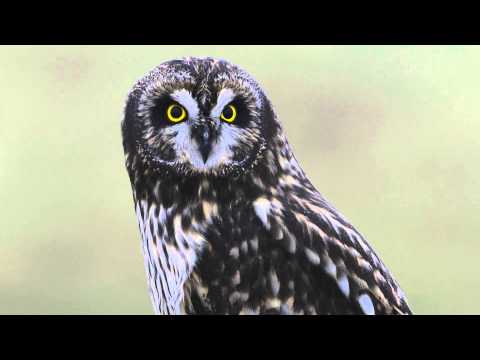
This mid-sized tawny-brown mottled owl is widely distributed across North America. These birds mostly hunt in the daytime when voles, their favorite meal, are active. Interestingly, they are one of the most common owls you can see during daylight hours!
Short-eared Owls are typically found in open country. Your best chance to spot them in ST*TE is at duck or dawn in fields, grasslands, meadows, or even airports.
Short-eared Owl Range Map

These owls build their nests on the ground in open areas. If obliged to flee its nest to draw off a predator, the parent will poop on the eggs so the smell will keep predators away. Similar to a Kildeer, Short-eared Owls also lure predators away from their nest by hopping away and pretending to be crippled.
Short-eared Owls are not particularly vocal. But when they do make noises, these birds have a call, oddly enough, that sounds an awful lot like a cat looking for a mate.
Length: 13–17 inches (34–43 cm)
Weight: 7.3–16.8 oz (206–475 grams)
Wingspan: 33.5-40.5 inches (85–103 cm)
Scientific Name: Asio flammeus
#3. Snowy Owl

Snowy Owls are one of the most stunning animals on the planet! Their white plumage stops almost everyone in their tracks, both birders and non-birders alike! Although they are mostly white, they have horizontal dark lines all over their bodies except the face and breast. Interestingly, individuals seem to get whiter with age.
Snowy Owl Range Map

Snowy Owls migrate with the changing seasons. During summer, they mate and breed in northern Canada on the tundra. But when winter arrives, these birds come south.
You never know how far south Snowy Owls will travel.
Most years, Snowy Owls only appear as far down as the northern USA. But some years, there is an “irruption” of Snowy Owls, and many more birds than normal migrate south.
When defending their territory or searching for a mate, males make a loud “hoo, hoo.” This hoot is so loud that it can be heard up to 7 miles away on the tundra! Females rarely hoot, but other noises (for both sexes) include cackles, shrieks, hissing, and bill snapping.

Length: 20.7–25.2 inches (52.5–64 cm)
Weight: 3.2–4 lb. (1,465–1,800 gram)
Wingspan: 48–60 inches (1.2–1.5 meters)
Scientific Name: Bubo scandiacus
#4. Boreal Owl

The Boreal Owl is an incredibly small owl found in Newfoundland and Labrador.
They can be tricky to identify because they have a variety of colors (from reddish-brown to gray) and patterns, even though it is genetically the same owl. They can possess either dots or streaks, and sometimes both on the top or bottom of the body.
Boreal Owl Range Map

Boreal Owls live in the boreal forests and can be seen in stands of aspen, poplar, spruce, fir, and birch trees. Because of their remote locations, these owls are relatively uncommon and hard to study and see, and not much is known about their population trends.
These owls like to perch low in coniferous forests and alpine areas and tilt their heads back and forth to scan for prey sounds with their extremely directional hearing. Once they have a target, they swoop in, and dinner is served. Since Boreal Owls are small, voles, bats, frogs, beetles, birds, and baby squirrels are their primary foods.
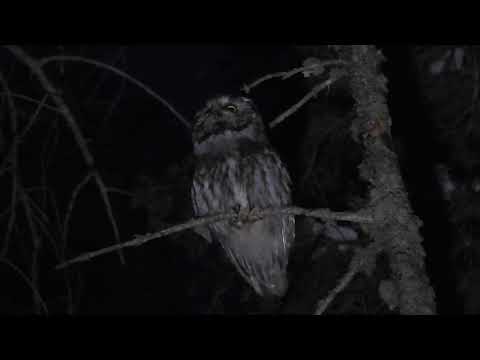
Their call is a small series of whistled toots that gets progressively louder. Males typically only hoot during the breeding season to attract a female.
Length: 9–10.5 inches (22–27 cm) long
Weight: 3.2–7 oz. (90-200 gr)
Wingspan: 20–24 inches (50–62 cm)
Scientific Name: Aegolius funereus
#5. Northern Hawk Owl

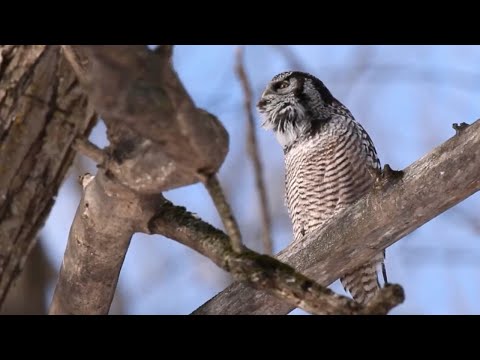
As the name suggests, Northern Hawk Owls tend to act more like hawks than owls! These owls sit solitary in tall trees and hunt during the day, which are rare traits in owls.
Northern Hawk Owl Range Map

These owls prefer northern climates and the boreal forest.
Northern Hawk Owls commonly feed on voles since they can be eaten whole and are generally plentiful. They also will eat baby hares, red squirrels, mice, rats, and lemmings. Smaller songbirds fit into their diet, too, such as robins, jays, starlings, grackles, finches, and sparrows.
Males make a rolling, low “hoo-hoo-hoo-hoo” sound repeated 10 to 200 times. Females have similar calls, but it’s shorter and hoarser.
Males make a rolling, low “hoo-hoo-hoo-hoo” sound repeated 10 to 200 times. Females have similar calls, but it’s shorter and hoarser.
Length: 14.2–17.75 inches (36–45 cm)
Weight: 11–12 oz (300–340 grams)
Wingspan: 31–35 inches (77–89 cm)
Scientific Name: Surnia ulula
Do you need additional help identifying owls?
Here are a few books and resources you can purchase that will provide assistance! (Links below take you to Amazon)
- Owls of North America by Frances Buckhouse
- Hang one of these interesting posters up in your house!
- To learn more about other raptors near you, check out these guides!
- 16 Types of Hawks That Live in Newfoundland and Labrador!
- Which owls have you seen before in Newfoundland and Labrador?
- Leave a comment below!

